I've been curious about alpha arbutin for a while, and I've now been using it on my own skin for over 12 weeks. What follows is what I've learned about the ingredient, how it compares to hydroquinone and the other brightening agents on the market, what percentage of arbutin holds up under a routine, and the two products I've been testing.
Fair caveat before I go further: I am not a dermatologist. I am a midlife woman who reads the research and tests things on her own skin. If you know more about a specific formulation than I do, tell me and I will update the piece.
The dark spot conversation used to have one serious answer: hydroquinone from your dermatologist. It works, but it comes with side effect risk (rebound pigmentation, ochronosis with long-term use, sensitization) and it's banned or restricted in many countries. For most women dealing with mild-to-moderate hyperpigmentation, hydroquinone is more tool than the situation calls for. Alpha arbutin is the answer that fills the gap. It works through the same tyrosinase-inhibition mechanism as hydroquinone, delivered through a gentler pathway, with a fraction of the risk and no prescription needed.
What alpha arbutin is.
Alpha arbutin is a naturally derived compound, structurally a glycosylated form of hydroquinone. It works by inhibiting tyrosinase, the enzyme responsible for triggering melanin production. Less melanin activity means fewer dark spots, more even tone, and over time, a brighter overall complexion.
There are two forms: alpha arbutin and beta arbutin. Alpha is the more stable, more studied, and more effective of the two. Beta arbutin is found naturally in bearberry plants and is gentler but also weaker at comparable concentrations. When you see "arbutin" on a label without a prefix, it's usually beta. When brands want you to know they're using the stronger form, they'll say alpha arbutin explicitly. If your goal is fading dark spots (not just gentle brightening), alpha arbutin is what you want on the label.
What makes alpha arbutin appealing is the safety profile. It's well-tolerated by most skin types, does not require a prescription, and does not carry the long-term risks associated with prolonged hydroquinone use. It's also compatible with most actives, which makes it easy to layer into an existing routine. And it works on multiple pigmentation types: sun damage, post-inflammatory hyperpigmentation (the marks left after breakouts), melasma, and general uneven tone.
- Sun spots and cumulative UV damage
- Post-inflammatory hyperpigmentation (PIH) after breakouts or irritation
- Melasma and hormonally triggered pigmentation
- Overall uneven tone and dullness
- Prevention of future pigmentation from continuing daily UV exposure
Alpha arbutin vs hydroquinone.
This is the comparison most people arrive at when they've heard about hydroquinone but are wary of the side effects, or when they've already tried hydroquinone and are looking for something they can use long-term without medical supervision.
For pure effectiveness, hydroquinone is stronger. It's the gold standard for a reason. At prescription concentrations (usually 4%), it produces the fastest and most visible fading of established hyperpigmentation. If you have severe pigmentation and access to dermatology, hydroquinone under supervision is a legitimate first choice.
For safety, alpha arbutin wins. Hydroquinone carries meaningful risks with prolonged use, including rebound pigmentation (dark spots that come back darker after you stop), ochronosis (a bluish-black skin discoloration that develops with extended use), and sensitization. It's banned or restricted in many countries because of these concerns. Alpha arbutin delivers the same tyrosinase-inhibition mechanism through a gentler pathway with none of those risks. It's what most of us would want to use long-term.
The pragmatic read most dermatologists now use: start with alpha arbutin, use it consistently for 3 to 6 months, and only consider hydroquinone if alpha arbutin has not produced enough change on stubborn pigmentation. For the vast majority of women dealing with sun damage, PIH, and general uneven tone in midlife, alpha arbutin at a proper concentration is the honest right answer.
Alpha arbutin vs kojic acid.
Kojic acid is the other well-known over-the-counter brightener, and the comparison shows up in almost every search around alpha arbutin. Both inhibit tyrosinase. Both are naturally derived. Both have decades of use in Japanese and Korean skincare.
The differences: kojic acid tends to work faster on established pigmentation, but it also sensitizes skin more easily and oxidizes quickly in formulation, which is why kojic acid products often turn yellow or brown over time and lose effectiveness. Alpha arbutin is more stable, gentler for reactive or perimenopausal skin, and better suited to daily long-term use. Kojic works well for shorter targeted treatment windows (three to four months on stubborn spots). Alpha arbutin works better as an ongoing part of a routine you plan to run for years.
For midlife skin specifically, alpha arbutin is usually the smarter pick. The barrier is thinner, reactivity is higher, and the daily long-term use pattern that alpha arbutin supports is what moves pigmentation over the timeline most of us care about. Kojic can be a good addition for a targeted spot treatment if you are dealing with something stubborn, but it is not what you want doing the main work.
Alpha arbutin and tranexamic acid: the stacking combo.
Tranexamic acid (TXA) is the other brightener that shows up alongside alpha arbutin, and it is worth understanding because the two ingredients stack unusually well. TXA works through a completely separate pathway: it interrupts the signal between skin cells and melanocytes that triggers pigmentation production in the first place. Alpha arbutin blocks the tyrosinase enzyme downstream. That means the two ingredients are attacking hyperpigmentation from different angles at the same time, and using them together produces measurably better results than either one alone.
This is why the Tosowoong formula pairs 7% alpha arbutin with 4% tranexamic acid in a single product. It is a smart formulation choice. TXA is also considered safer than hydroquinone for long-term use and has decent published data on melasma specifically, which is one of the harder pigmentation patterns to treat.
If you are seeing an alpha arbutin product formulated with TXA, that is usually the version to reach for. The stacking gets you more brightening for the same routine time.
Alpha arbutin for melasma.
Melasma is the pigmentation pattern that tends to correlate with hormonal shifts (pregnancy, oral contraceptives, perimenopause) and shows up most often on the cheekbones, forehead, upper lip, and jawline in symmetrical patches. It is one of the harder pigmentation types to treat because the underlying trigger is hormonal, which means topical treatment alone cannot fully resolve it.
Alpha arbutin has moderate data on melasma. Not the strongest option, but a legitimate part of a treatment stack, especially when combined with tranexamic acid (which has better melasma-specific evidence than most other topical brighteners). For midlife melasma specifically, the honest read is: alpha arbutin + tranexamic acid + daily SPF is a reasonable starting stack, but if melasma is severe or unresponsive after 3 to 4 months, a dermatology conversation about oral tranexamic acid or in-office treatments (IPL, picosecond laser, Cosmelan) is worth having.
Alpha arbutin for sun spots.
Sun spots (also called solar lentigines) are the most common pigmentation type in midlife women, especially anyone who spent summers outdoors before daily SPF was standard advice. These are the discrete flat brown spots that show up on the cheekbones, forehead, hands, chest, and shins over time.
This is where alpha arbutin performs best. Sun spots respond well to daily tyrosinase inhibition because the underlying trigger (UV exposure and accumulated pigment) can be controlled with daily SPF while the arbutin does its work fading what is already there. Twelve to sixteen weeks of consistent use produces visible fading for most people, and continued use through six months keeps improving the picture. This is the pigmentation type I have been treating on my own skin.
Alpha arbutin for post-inflammatory hyperpigmentation.
Post-inflammatory hyperpigmentation (PIH) is the dark mark that stays behind after a breakout or a spot of irritation heals. It is common in perimenopausal skin because hormonal breakouts show up in new ways and the recovery from any inflammation slows down. PIH tends to respond faster to alpha arbutin than melasma does, because the trigger (the initial inflammation) is already resolved by the time you start treating the mark. Six to eight weeks of consistent daily use produces meaningful fading on PIH for most people, sometimes faster than on sun spots.
What concentration of alpha arbutin holds up.
The published research on alpha arbutin generally uses concentrations between 2% and 7% in the finished formula. Below 2%, results are weak or unmeasurable. Above 7%, there are diminishing returns and increased risk of sensitization for reactive skin.
The sweet spot for most women is 5% to 7%. That is high enough to produce measurable results within the 8 to 12 week window most of us care about, and low enough to be well-tolerated on midlife skin. If a product does not disclose the arbutin percentage, that is information. Brands that use meaningful concentrations usually put the number on the label because it is a selling point.
Alpha arbutin during pregnancy and breastfeeding.
This comes up often enough that it is worth naming. The honest answer is that there is not enough human safety data on topical alpha arbutin during pregnancy or breastfeeding to give a confident yes. Most dermatologists err on the side of avoiding it because alpha arbutin is structurally related to hydroquinone, which is generally advised against during pregnancy.
If you are pregnant or breastfeeding and dealing with melasma (which is common in pregnancy specifically), the safer alternatives are azelaic acid (which has solid pregnancy safety data), vitamin C, niacinamide, and daily strict SPF. Talk to your OB or dermatologist before adding any brightening agent during pregnancy. This is one of the situations where dermatology guidance is worth having.
Does alpha arbutin fade dark spots.
Yes, with consistent use over enough time. This is the answer to the question everyone is asking.
Alpha arbutin is one of the most well-studied over-the-counter brightening ingredients. Published clinical evidence shows meaningful reduction in hyperpigmentation with consistent daily use, typically measurable at the 8 to 12 week mark. It works on sun spots, PIH, melasma, and general uneven tone. It doesn't bleach or strip skin. It regulates the melanin production process at the source.
The catch is time. Alpha arbutin is not a fast ingredient. Anyone selling you a 2-week transformation with alpha arbutin is selling you either a misunderstanding of the chemistry or the expectation of disappointment. Meaningful results come from consistency over 12 weeks minimum, with continued improvement out to 6 months and beyond.
Weeks 4 to 6: subtle brightness improvement, skin looks slightly more even in natural light. Weeks 8 to 12: visible fading at the edges of existing spots, meaningful tone change starts. Weeks 12 to 16: the window most people mean when they talk about arbutin "working." Months 6+: stubborn pigmentation continues to fade. Skip applications and the response curve resets.
The alpha arbutin creams worth trying.
Not all alpha arbutin products are formulated the same way. Concentration is significant (5 to 7% is the sweet spot), format is significant (creams tend to be more stable than watery essences), and the supporting ingredients around the arbutin influence how quickly and evenly you see results. Two products earn their place in this conversation, at very different price points, for very different situations.
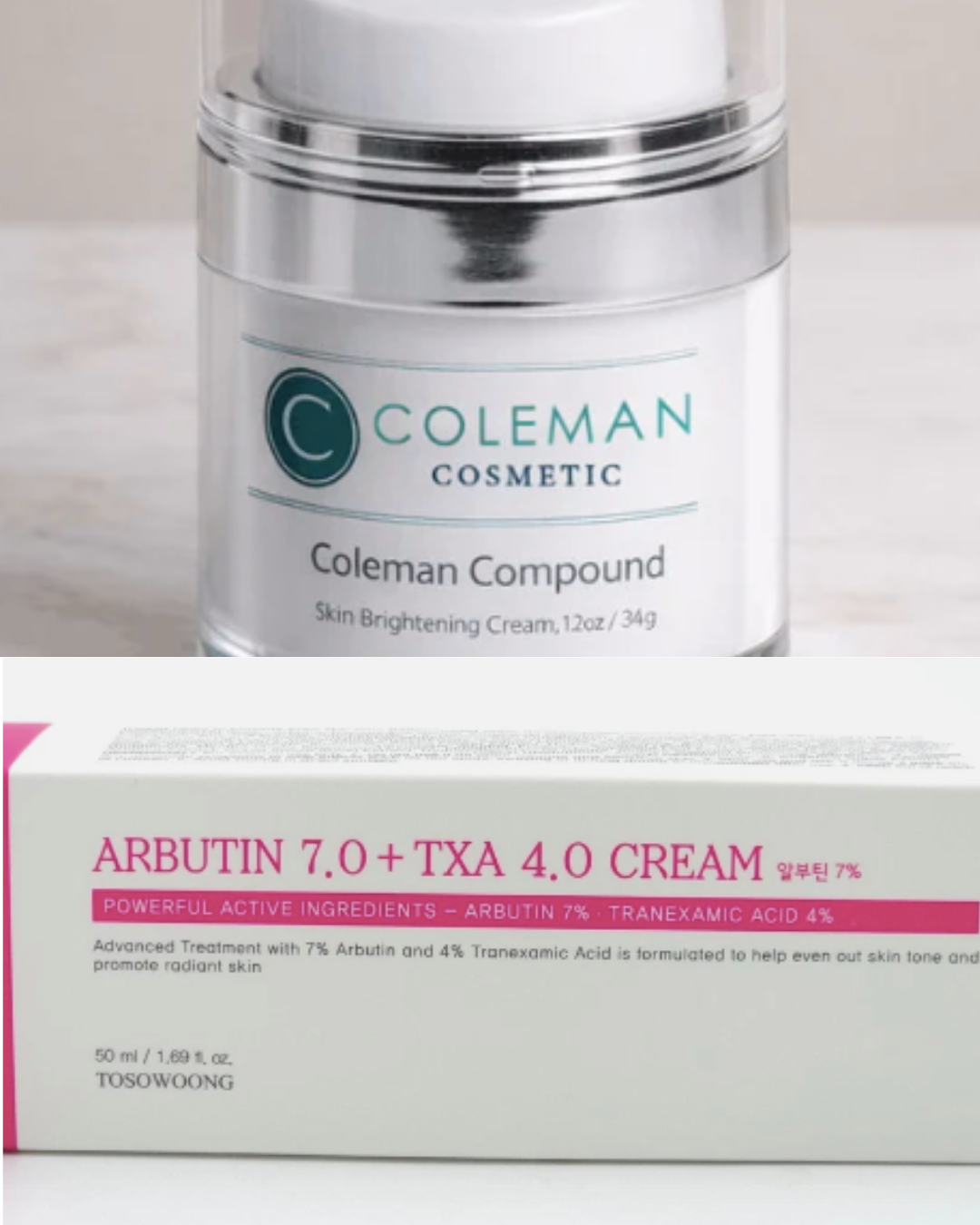
Coleman Compound cream (the splurge)
Coleman Compound is a compounded arbutin formulation from Mrs Derm and her husband, a dermatologist, who launched a small curated collection focused on the three concerns that show up most in midlife skin: pigmentation, hydration, and redness. The cream combines enzyme-activated arbutin with supporting brighteners including glycolic acid, vitamin C ester, vitamin E, and green tea. This is not a single-ingredient brightener, it is a multi-mechanism approach. Arbutin suppresses melanin production, glycolic acid accelerates cell turnover and fades existing pigment, vitamin C ester adds antioxidant protection and additional brightening, and green tea brings anti-inflammatory support.
I have been using the cream and reordering it. I also tried the CC Brightening Pads. They are a step stronger than the cream, and for my sensitive skin they were too much on my face. I moved them to my chest and arms instead, where they have been working well. Over months of consistent use I have noticed clearer, more even skin. That is not a dramatic before-and-after claim. It is a consistent observation over enough time that I trust it. The price is meaningful (around $140 direct), and it is worth it if hyperpigmentation is your primary concern and you want a formula built around multi-mechanism brightening rather than a single active.
Tosowoong Arbutin 7.0 + TXA 4.0 (the accessible option)
Tosowoong is a Korean brand with a straightforward ingredient-forward philosophy, and their Arbutin 7.0 + TXA 4.0 Cream punches above its price tag. At 7% alpha arbutin plus 4% tranexamic acid, this is a two-mechanism brightener at a fraction of the Coleman Compound price. Tranexamic acid works through a separate pathway (it interrupts the signal between skin cells and melanocytes that triggers pigmentation) which means the two ingredients are attacking hyperpigmentation from different angles simultaneously.
At around $25 on Amazon versus Coleman Compound's $140, the price difference is significant. Whether the formulation difference justifies that gap depends on what your skin needs. For someone with moderate dark spots looking for a solid effective option without a splurge, the Tosowoong is a very reasonable choice. For someone dealing with cumulative sun damage who wants a more sophisticated multi-mechanism formula, Coleman Compound is worth the splurge.
- Coleman Compound cream if hyperpigmentation is your primary concern, you have sensitive skin like me, and the $140 fits your skincare budget.
- Coleman Compound Brightening Pads if you can tolerate a stronger formulation on the face, or if you want to use them on chest, arms, and body where pigmentation shows up in midlife.
- Tosowoong Arbutin 7% + TXA 4% if you want alpha arbutin at a strong concentration without a big commitment, or if you are layering it as one part of a broader routine.
- Either requires the same discipline: daily use for 12+ weeks, SPF every morning without exception, and realistic expectations about the timeline.
Arbutin is one of four brighteners that work well in a midlife hyperpigmentation routine. For how to layer arbutin, azelaic acid, vitamin C, and tranexamic acid together, with the five-layer framework I use for my own skin, see The Pigmentation Stack: 5 Layers That Fade Dark Spots.
How to use alpha arbutin.
The protocol counts more than the product. A poorly used strong alpha arbutin produces worse results than a well-used moderate one.
Routine placement
Alpha arbutin is water-soluble and goes early in your routine, after cleansing and toning, before heavier serums, moisturizer, and SPF. Compatible with most actives including niacinamide (which also supports brightening), hyaluronic acid, peptides, and retinoids. If pairing with a retinoid at night, apply alpha arbutin first, let it absorb for 2 to 3 minutes, then apply the retinoid.
Frequency
Once daily is the baseline. Twice daily (AM and PM) is fine for most users. The one consideration: if you're using vitamin C in the morning, put alpha arbutin in the PM. There's no chemical conflict, but the layering is cleaner when they're on separate routines. Vitamin C AM, alpha arbutin PM is the simple template.
SPF is non-negotiable
Alpha arbutin prevents new melanin from forming, but UV exposure triggers the exact process it's trying to suppress. Without daily broad-spectrum SPF, you're fighting against yourself. Consistent SPF application is what allows alpha arbutin to do its job. See the full sunscreen guide for the picks I use.
Common mistakes.
Quitting at week 4. The biggest reason women don't see results from alpha arbutin is they stop before it has a chance to work. Meaningful fading takes 12 weeks minimum. If your skin is tolerating it well at week 4, keep going.
Skipping SPF. Alpha arbutin without SPF is a treadmill. You're using an ingredient designed to prevent melanin formation while continuing to trigger melanin formation daily with UV exposure. The two cancel out.
Buying beta arbutin and expecting alpha results. If the label just says "arbutin" without the "alpha" prefix, it's usually beta and won't work as fast. Look for "alpha arbutin" specifically.
Layering too many actives. If you're already running a full retinoid + AHA + vitamin C routine, adding alpha arbutin to that stack may sensitize skin without accelerating results. Consider whether your current routine is doing enough of the brightening work already before adding.
Expecting a bleaching effect. Alpha arbutin regulates pigment production, it does not strip pigment. Skin will look more even and clearer over time. It will not look "lighter" in a bleaching sense. If lightening (rather than fading dark spots) is your goal, alpha arbutin is not the right tool.
Frequently asked questions
What is alpha arbutin?
A naturally derived compound that inhibits tyrosinase, the enzyme responsible for melanin production. Structurally a glycosylated form of hydroquinone, delivering the same brightening mechanism through a gentler pathway. Alpha arbutin is more stable and more effective than beta arbutin, which is what you want on a product label if brightening is your goal.
Does alpha arbutin fade dark spots?
Yes, with consistent use. Published studies show meaningful reduction in hyperpigmentation over 8 to 12 weeks. Realistic expectation: visible fading at 8 weeks, meaningful change at 12 to 16 weeks, continued improvement at 6+ months.
Alpha arbutin vs hydroquinone: which is better?
For pure effectiveness, hydroquinone is stronger. For safety, alpha arbutin wins. Hydroquinone carries significant long-term risks (rebound pigmentation, ochronosis, sensitization) and is banned or restricted in many countries. For most women with mild to moderate dark spots, alpha arbutin is the honest right answer. Hydroquinone stays useful for severe cases under dermatologist supervision.
How long does alpha arbutin take to work?
Early brightness at 4 to 6 weeks. Visible fading at 8 to 12 weeks. Meaningful change at 12 to 16 weeks. Continued improvement at 6+ months. Skipping applications resets the response curve.
Can you use alpha arbutin every day?
Yes. Well-tolerated for most users, applied morning or evening, daily. Water-soluble so it goes early in the routine, after cleansing and before heavier serums. Compatible with niacinamide, hyaluronic acid, peptides, and retinoids. SPF the next morning is non-negotiable.